ARF the Advertising Research Foundation
  • Membership
  • Research
  • Access Knowledge
  • Communities
  • Events
  • About the ARF

home

Membership

  • Committees & Boards
  • Events
  • Self Service Research
  • Member Bulletin Board

Research

  • Recent ARF Research
  • Programs & Resources
  • Research Focus Topics
  • ARF DASH: Annual TV Universe Study

Access Knowledge

  • Topics
    • Ad Effectiveness & ROI
    • Analytics & Data Science
    • Audience & Media Measurement
    • Creative & Branded Content
    • Future States & AI
    • Past Event Highlights
    • Research & Data Quality
    • Targets & Segments
  • Find a Solution
    • 2025 Top Member Questions
  • Publications
    • News You Can Use
    • March 2026: Journal of Advertising Research
    • Knowledge at Hand
    • CMO Briefs

Events

  • Upcoming ARF Events
    • View All Upcoming Events
    • Upcoming Conferences
    • Upcoming Young Pros
  • Insights Studios
    • Upcoming Insights Studios
    • Past Insights Studios
  • Town Halls
    • Upcoming Town Halls
    • Past Town Halls
  • Past Event Highlights
  • Submit

Communities

  • Young Pros
    • About Young Pros
    • Upcoming Events
    • Advisory Board
    • Young Pros Spotlight
    • Social Strategist Team
    • Past Events Highlights
  • Women in Analytics
    • About Women in Analytics
    • Board of Directors
    • Mentorship Program
    • Upcoming Events
    • Past Events Summaries
  • Councils
    • Learn About the Council Program
    • ANALYTICS COUNCIL
    • MSI/ARF B2B Exchange
    • CREATIVE COUNCIL
    • COGNITION COUNCIL
    • CROSS-PLATFORM COUNCIL
    • CULTURAL-EFFECTIVENESS COUNCIL
    • LA MEDIA RESEARCH COUNCIL
    • ORGANIZATIONAL COUNCIL
    • PHARMA COUNCIL
    • SHOPPER INSIGHTS COUNCIL
    • SOCIAL COUNCIL

About ARF

  • About the ARF
  • ARF Board of Directors & Trustees
  • ARF Leadership Team
  • Marketing Science Institute (MSI)
  • Coalition for Innovative Media Measurement (CIMM)
  • Member Directory
  • ARF Awards
  • ARF In the Press
  • Press Kit
  • Contact Us
  • NYU/ARF Certificate in Marketing Optimization & Insights Certificate
  • ARF WIDE
  • ARF DASH: Annual TV Universe Study

My Account

  • Login
  • Create an Account

Invalid login. Please try again.

Password does not meet the required minimum length of 7.

What Low Response Rates Mean for Telephone Surveys

August 30, 2017

via Pew Research (A detailed report is available via the link below)

Telephone polls still provide accurate data on a wide range of social, demographic, and political variables, but some weaknesses persist. After decades of decline, the response rates for telephone polls like those conducted for Pew Research Center have stabilized in recent years to around 9% (see table below).
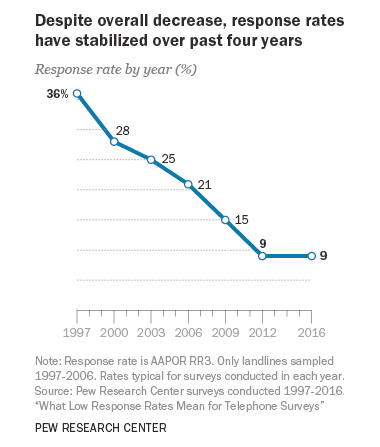
graph

Telephone poll estimates for party affiliation, political ideology, and religious affiliation continue to track well with estimates from high response rate surveys conducted in-person, e.g. General Social Survey. So even at low response rates, telephone surveys that include interviews via landlines and cellphones, and that are adjusted to match the demographic profile of the U.S., can produce accurate estimates for political attitudes.

The fact is that national polls (in 2016) were actually quite accurate. Collectively, they indicated that Clinton had about a 3 percentage point lead nationally and she ultimately won the popular vote by 2 points. Furthermore, according to a new report, there are clear reasons why national polls as a group fared better than state polls. For instance, national polls were much more likely than state polls to adjust for respondent education level in their weighting, which proved critically important in the 2016 election.

Live interviewer phone polls now represent a minority share of all polling conducted in the U.S. Online polls and automated (Interactive Voice Response) polls, or combinations of the two, are collectively more common and tend to have significantly lower response rates. Response rates to online opt-in surveys are so low as to be incomputable because far more internet users are invited to join opt-in survey panels (or to take one-off online surveys) than actually do so.

Read entire article on Pew Research

Add a Comment Cancel reply

You must be logged in to post a comment.

  • Topics
    • Ad Effectiveness & ROI
    • Analytics & Data Science
    • Audience & Media Measurement
    • Creative & Branded Content
    • Future States & AI
    • Past Event Highlights
    • Research & Data Quality
    • Targets & Segments
  • Find a Solution
    • 2025 Top Member Questions
  • Publications
    • News You Can Use
    • March 2026: Journal of Advertising Research
    • Knowledge at Hand
    • CMO Briefs

Trending

    • Targets & Segments
    • Article

    Privacy, Trust & AI: How U.S. Consumers Are Rewriting the Rules of Advertising

    • Targets & Segments
    • Article

    When Style Becomes Signal: How Gendered Language Shapes Generative AI Output

    • Targets & Segments
    • Article

    When Language Becomes Targeting: How Gender Cues Shape AI Recommendations

    • Audience & Media Measurement
    • Article

    Traversing Data Silos: A Practical Framework for Identity Crosswalks in Advertising

    • Audience & Media Measurement
    • Article

    The Convergence of Content and Commerce: The Case of Shoppable Ads

Activate your Member Benefits

  • ABOUT
  • ARF DASH
  • ARF WIDE
  • ARF/NYU CERTIFICATE
  • CIMM
  • MSI
  • PRESS
  • SUBMIT
image description

To further, through research, the scientific
practice of advertising and marketing

© the Advertising Research Foundation. All rights reserved.

Privacy Policy | Request Permission to Use Content