To further, through research, the scientific practice of advertising and marketing.

When the Advertising Research Foundation was established in 1936, its founders articulated a mission that has endured for nine decades:

To further, through research, the scientific practice of advertising and marketing.

The statement is notable not just for what it says, but more for what it does not say. It does not promise policy advocacy. It does not promise market dominance. It promises methodological rigor and discipline.

The inclusion of the word “scientific” was deliberate. In 1936, advertising was already a powerful economic engine. National brands were expanding rapidly. Media channels were multiplying. Consumer markets were becoming increasingly national in scale. Yet the systems used to measure audiences and marketing performance lacked consistency and comparability.

Research existed, but it was fragmented and vulnerable to biases of interested parties. Different media relied on different metrics. Methodologies varied widely. Comparative evaluation across channels was limited. Advertisers invested significant budgets without uniform standards for validating results.
The founders of the ARF recognized a structural vulnerability. Without disciplined research infrastructure, advertising risked undermining its own credibility. The ARF was created to address that vulnerability — not through promotion, but through independent and objective industry-wide effort to develop best practices and methods for measurement, attribution, forecasting, creative development, and market strategy.

Ninety years later, the environment has changed beyond recognition. Print, radio and out-of-home have been joined by television, digital display, social media, gaming and a host of other media formats. Retailers have become media companies, and visa-versa.  Video has migrated from TV sets to desktops to mobile phones and on from there to the internet-of-things. Artificial intelligence now promises to reshape both marketing and the research process itself.

Yet the essential mandate remains unchanged: advertising must justify itself through validated evidence.

The story of the ARF is the story of how the industry built, reinforced, and redefined its scientific foundations across successive waves of disruption.

Download 90 Years of Advancing the Science of Advertising & Marketing
Commemorative Anniversary Edition


1930S - 1940S: Establishing Research Legitimacy

1936 — ARF Founded by 4As and ANA

1938 — Radio Surpasses Magazines in Advertising Revenue
Marks the shift to electronic mass media and the need for more sophisticated audience measurement systems.

1939 — Copy Testing Report
One of the earliest structured efforts to measure advertising effectiveness scientifically, helping legitimize copy testing as a research-based discipline.

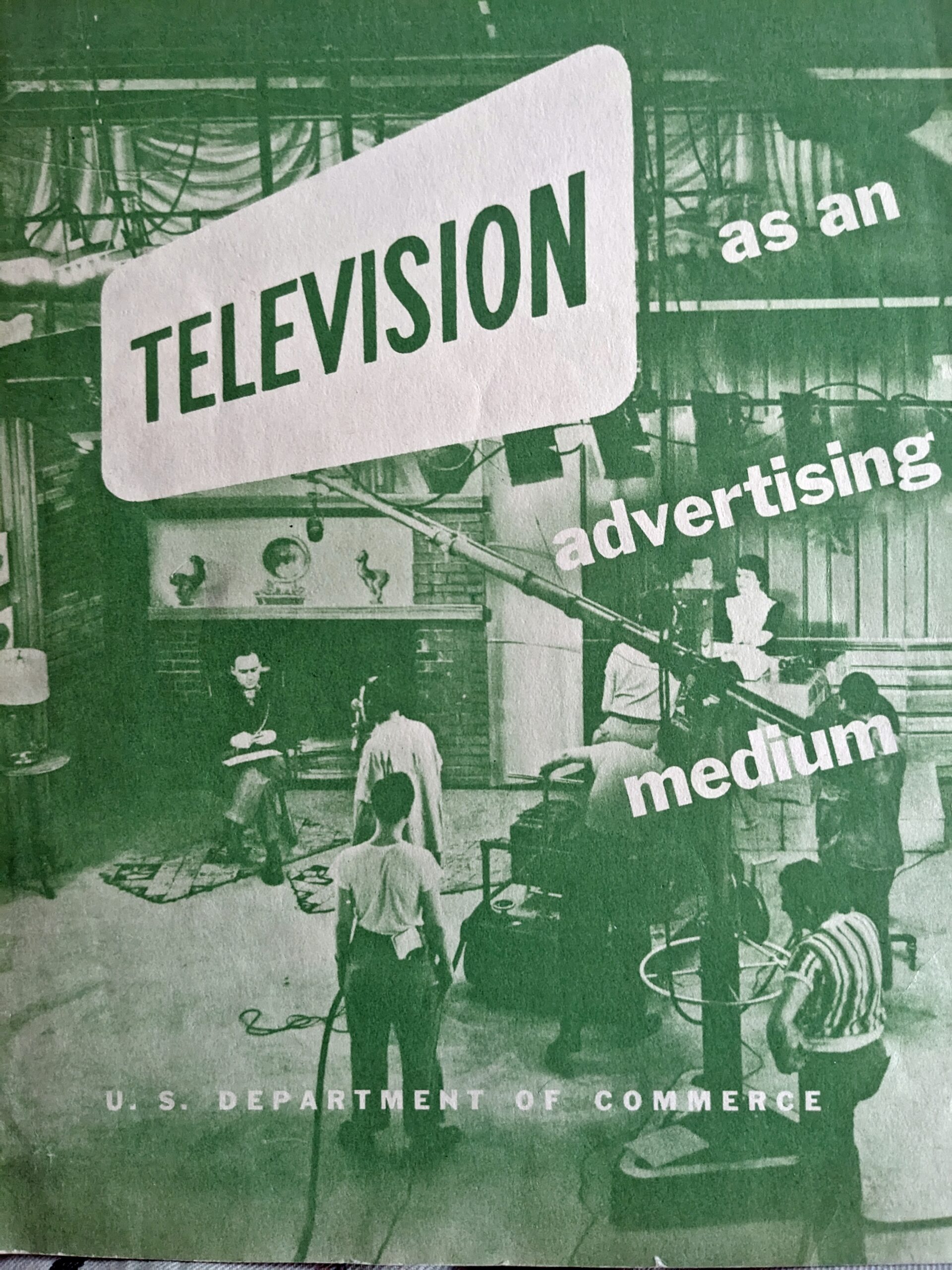
1941 — First Television Commercial Airs
Signals the beginning of television advertising and the future expansion of broadcast measurement standards.

1949 — Canadian Magazine Study
The first complete probability sample of a nation’s adult population, demonstrating that advertising research could meet the highest statistical standards.

1949 — Chicago Sun-Times Circulation Study
Expanded sample sizes and elevated expectations for rigor in print measurement.

1950S–1960S: Broadcast Growth and Conceptual Architecture

1954 — ARF Publishes Measurement Standards for TV and Radio
Established formal standards for broadcast measurement during television’s rapid expansion.

1954 — National Survey of Radio & TV Ownership
The first national survey of broadcast device ownership in the U.S., strengthening foundational media metrics.

1955 — Television Ownership Measured by the U.S. Census
Following ARF advocacy, television ownership began to be measured by the U.S. Census in an annual study, until it was incorporated into the decennial census in 1965—embedding advertising metrics into national statistical infrastructure.

1956 — Videotape Enables Pre-Recorded Commercials
Technological innovation reshapes production, scheduling and measurement possibilities.

1960 — Journal of Advertising Research (JAR) Founded
The first academic journal devoted exclusively to advertising and marketing research, institutionalizing scientific dialogue in the field.

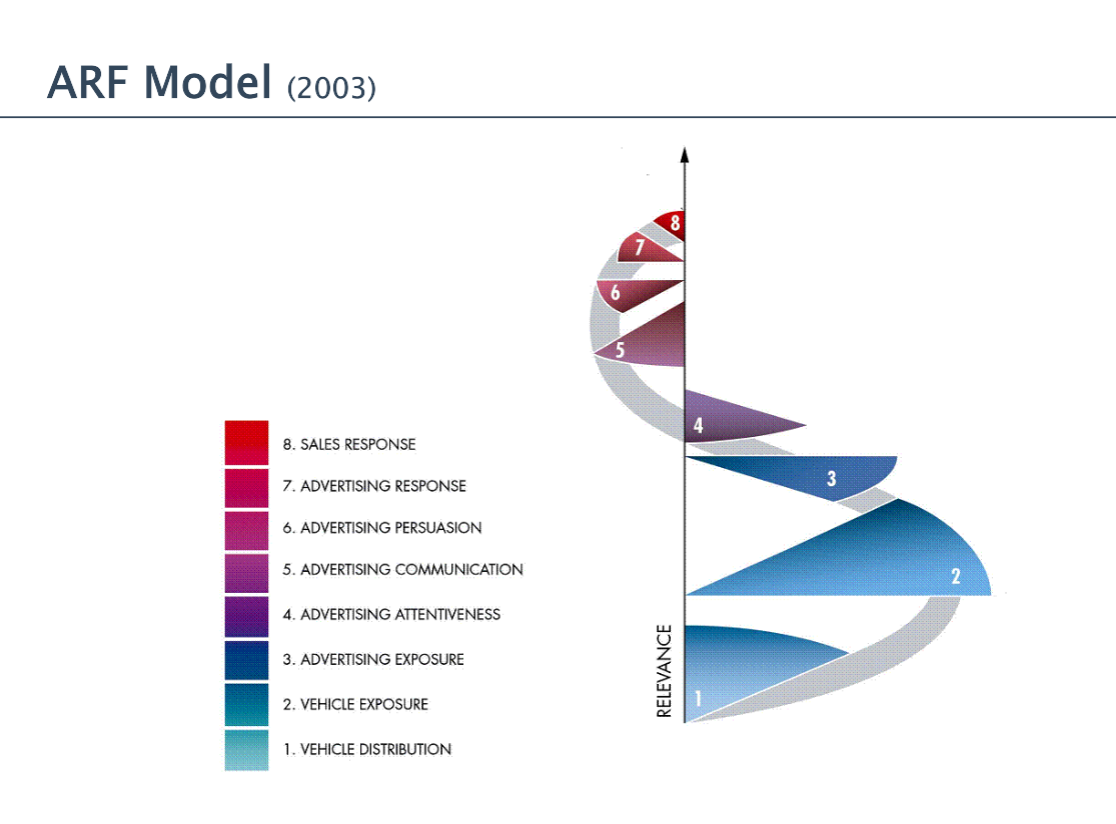
1961 — The ARF Media Model
Introduced a shared framework for understanding media performance from exposure to persuasion to sales — a conceptual architecture still influential today.

1961 — Marketing Science Institute (MSI) Founded
The institute was created to establish marketing as a rigorous scientific discipline.

1963 — Media Rating Council (MRC) Established
Created at the request of the U.S. Congress in the wake of the Quiz Show Scandals, the MRC became the industry’s self-regulatory auditing body to ensure media measurement services are valid, reliable and ethically conducted.

Late 1960s — MSI Advances Scientific Marketing Infrastructure
MSI relocates to Cambridge and begins collaboration with Harvard Business School, strengthening ties between academic research and executive practice.

The ARF Media Model

MSI Meeting

MSI Monograph Series

1970S–1980S: Validation and Accountability

1969 — FACT Fieldwork Certification Program
Established audit and certification standards for research quality control.

Early 1970s — MSI Launches PIMS (Profit Impact of Marketing Strategy)
A landmark cross-sectional database (with GE) linking marketing strategy to profitability, demonstrating empirical connections between market share, quality and ROI.

1977 — Project Payout
Linked advertising and promotion directly to supermarket sales in controlled environments, foreshadowing scanner-based measurement.
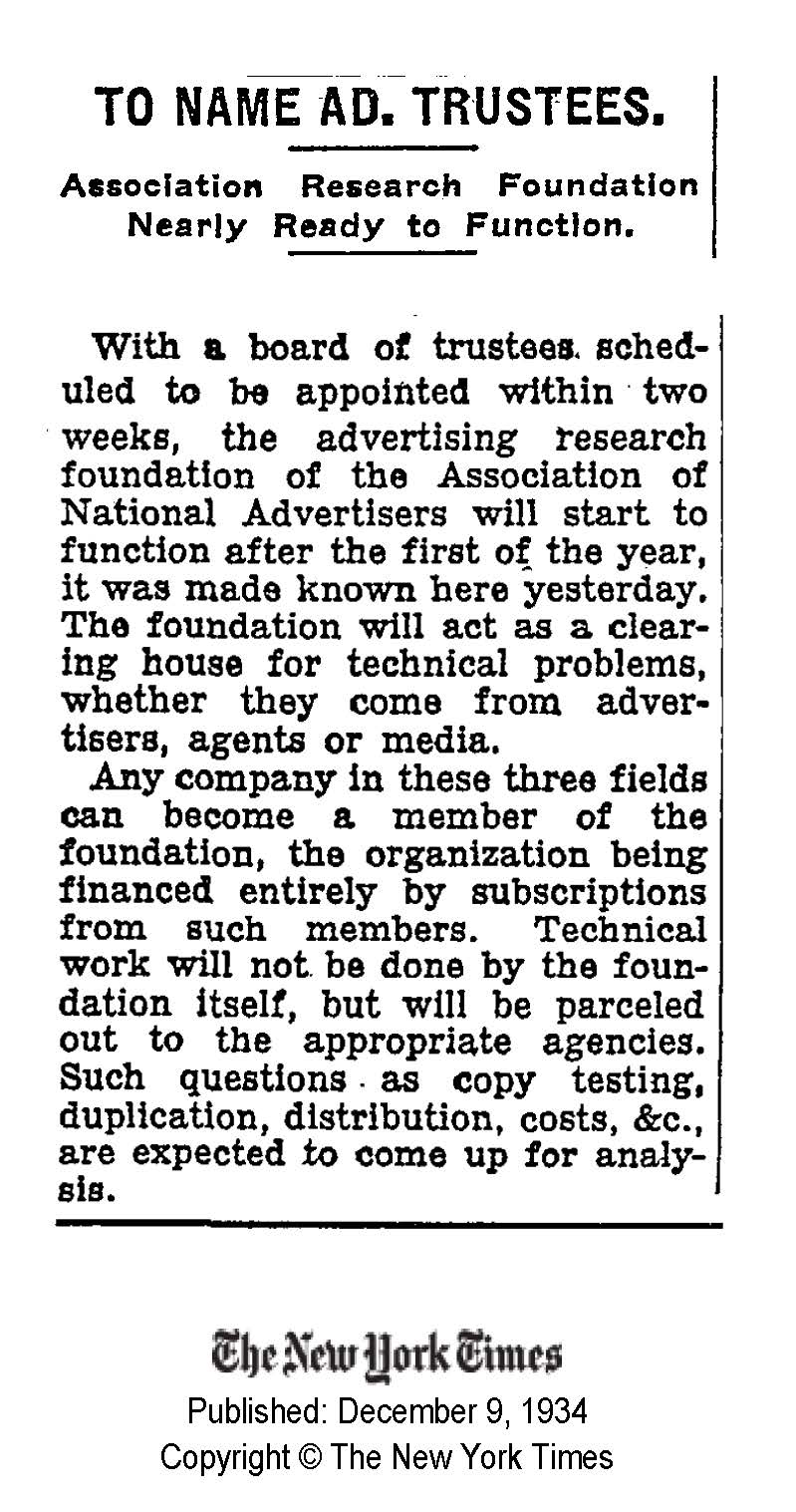
Read a New York Times article about the project.

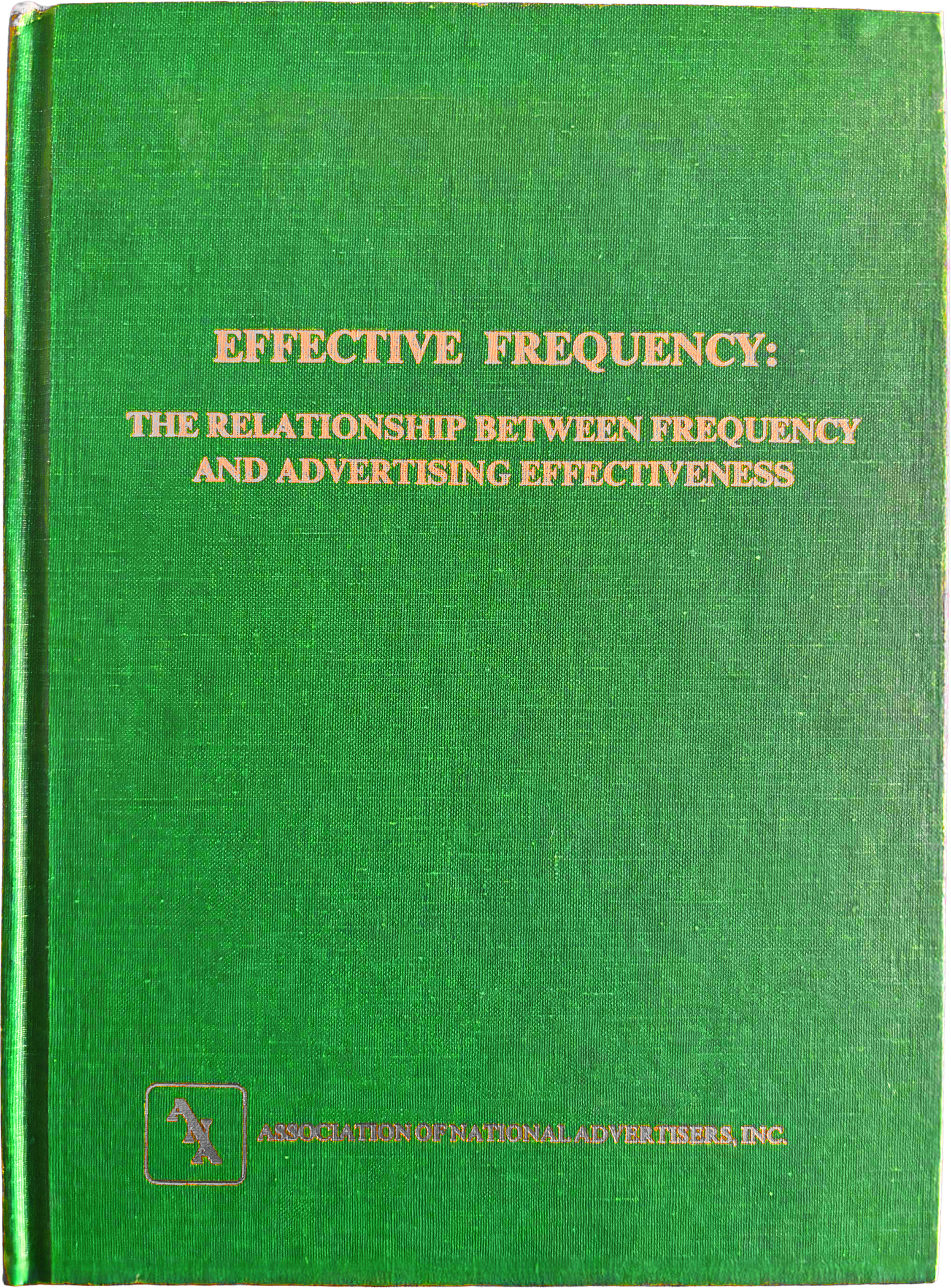
1979 —  ANA Publishes “Effective Frequency: The Relationship Between Frequency and Advertising Effectiveness”
This was based largely on research from the ARF (with some contributions from MSI).

1979 — U.S. Advertising Spend Reaches $27.9B
Reflects the scale and economic importance of advertising entering the modern era.

Late 1970s–1980s — MSI Shapes Policy & Consumer Research
MSI assembled expert teams influencing FTC and USDA policy discussions and helped introduce qualitative consumer research methods, including foundations of consumer ethnography.

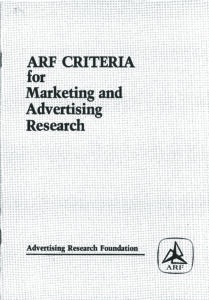
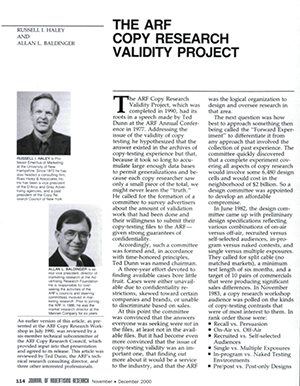
1981 — Copy Research Validation Initiative
Tested copy testing systems against real-world outcomes, reinforcing predictive validity.

1982 — PACT Principles Established
Codified nine principles for responsible copy testing, shaping creative evaluation standards.

1989 — The World Wide Web Is Launched
Signals the coming transformation of media, commerce and measurement.

1989 — Behavior Scan Study Presented at ARF
Advanced single-source measurement linking ad exposure to purchase behavior.

Effective Frequency: The Relationship Between Frequency and Advertising Effectiveness

1990S: Digital Emergence and Measurement Reform

Early 1990s — MSI Research Advances Brand Equity & Marketing ROI
MSI-sponsored work formalized brand equity measurement and expanded frameworks for marketing accountability and return on marketing investment.

1991 — Copy Validity Project
Validated whether copy metrics could identify known marketplace winners, reinforcing multi-metric evaluation. 

1991 — National Measurement Committee Formed
Repositioned ARF as a central forum for ratings reform and accountability.

1994 — Effective Frequency Debate Catalyst
Challenged long-held assumptions about reach and repetition, reshaping media planning dialogue.

1995 — Recency Theory Presented at ARF (Erwin Ephron)
Influenced modern media scheduling by reframing the role of timing in advertising effectiveness.

Mid-1990s — Guiding Principles for Interactive Media Measurement
Helped define early digital measurement standards amid fragmentation.

2000S: Cross-Platform Complexity

2002 — MSI Launches “Relevant Knowledge” Monograph Series
Bridged academic insights and executive decision-making in areas including innovation, social networks and marketing ROI.

2003 — Media Model Updated for Digital Integration
Adapted the ARF Media Model to incorporate internet and interactive media.

2004 — Majority of U.S. Homes Connected by Broadband
Accelerated the urgency of digital measurement innovation.

2005 — Audience Measurement Symposium Launched
Precursor to AUDIENCEXSCIENCE, creating a collaborative forum for cross-platform accountability.

2006 – Capitol Topic “The Connected Customer” added to MSI Research Priorities guiding academic research.

2009 — JAR Special Issue: “What We Know About Advertising
Synthesized decades of empirical research into a consolidated evidence base.

2009 — Coalition for Innovative Media Measurement (CIMM) Founded
CIMM was stablished by television networks, agencies and advertisers to improve cross-platform audience measurement. 

2010S: Neuro, ROI, Privacy and Ecosystem Expansion

2010 — Five co-sponsored conferences outside the U.S. expand MSI global connection.

2010–2011 — CIMM USA TouchPoints & Cross-Platform Pilots
Introduced hub-and-fusion methodologies to understand cross-media consumption, including early three-screen pilot studies.

2011 — CIMM TAXI Initiative Begins
Laid groundwork for standardized cross-platform asset identification using Ad-ID and EIDR.

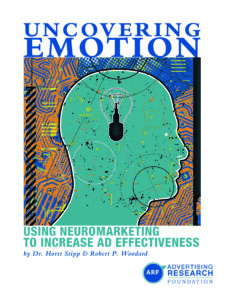
2010–2013 — NeuroStandards Collaboration & Neuro Studies Presented
Independent evaluations of neuromarketing vendors brought transparency and comparability to emerging neuroscience methods.

2013 — CIMM Data Warehouse RFP & SMPTE Collaboration
Advanced centralized cross-platform video measurement infrastructure and standards.

2014 — Connected Devices Surpass Global Population
Marked a structural shift toward multi-device consumer behavior.

2016–2017 — How Advertising Works: Ground Truth Experiments
Large-scale analysis of 5,000 campaigns across 12 years and 41 countries, demonstrated cross-channel synergy and strengthened ROI modeling frameworks.

2017–2026 — ARF Privacy Study (Annual Longitudinal Benchmark)
Tracks consumer attitudes toward data use, institutional trust, and digital advertising transparency over time.

2018 — CIMM Joins the ARF
Expanded ARF’s cross-platform measurement and data calibration capabilities.  

2019 — Research Leadership Committee (RLC) Formed
Formalized practitioner governance in research prioritization.
Learn more about the RLC.

2020S: Streaming, Attention and Artificial Intelligence

2020 — Marketing Science Institute (MSI) Joins the ARF
Strengthened interdisciplinary collaboration between academia and industry.

2021 — ARF DASH Study (with NORC) Launched
Produced granular, household-level streaming and device data to support cross-platform calibration.

2022 — Large Language Models Become Market-Ready
The commercialization of LLMs accelerated AI integration into research, analytics and creative workflows.

2022–2026 — Attention Measurement Validation Initiative
Systematic evaluation of attention metrics for reproducibility, validity and practical application in media buying.

2024–2026 — Handbook for Using AI in Advertising Research
Published guidance on responsible AI implementation across survey design, translation, coding and reporting.

2025–2026 — Psychology of GenAI Research Series
Experimental work examining how generative AI systems replicate — and diverge from — human cognition, defining boundaries for AI-assisted research.

The ARF’s Throughline 

Across nine decades, the pattern is consistent: 

When new media emerge, the ARF strengthens measurement. 
When methodologies proliferate, the ARF validates them. 
When systems fragment, the ARF calibrates them. 
When trust is challenged, the ARF reinforces standards. 
When new technologies appear, the ARF tests them. 

To further, through research, the scientific practice of advertising and marketing. 


The Expanded Throughline 

Across nine decades: 

  • ARF institutionalized advertising research. 
  • MSI advanced the scientific foundations of marketing strategy and ROI. 
  • CIMM engineered cross-platform and return-path innovation. 

Together, these organizations shaped the architecture of modern marketing science and media measurement. 

To further, through research, the scientific
practice of advertising and marketing

© the Advertising Research Foundation. All rights reserved. – Privacy Policy